John Singer Sargent's Watercolors

Updated: Oct 13

Want to know a secret? When most people think of John Singer Sargent, they picture the dazzling society portraits done in oil paint, like the one in Sargent's Deadly Commission. But whenever Sargent could step away from the grand salons and aristocratic drawing rooms, he enjoyed painting with watercolors.
These paintings, created primarily in the last three decades of his life, reveal an artist painting not for patrons but for himself. They’re intimate, loosely experimental, and surprisingly modern.
This post contains affiliate links throughout. As an Amazon Associate, I earn from qualifying purchases made through these links at no extra cost to you.
When and Where Sargent Painted His Watercolors
Sargent began working seriously in watercolor in the 1890s, at a moment when he was growing weary of the relentless demands of portrait commissions. By the early 1900s, he had pretty much abandoned portraiture altogether, turning instead to landscapes, architecture, and scenes of daily life in the many places he visited.
He painted extensively in Venice, one of his favorite subjects, where he explored shimmering canals, shadowed passageways, and the interplay of light on water. Rather than depicting famous landmarks in a formal way, he often chose unexpected angles—cropped compositions of gondolas, close studies of reflections, or quiet corners tourists might overlook.
His journeys also took him to Spain, North Africa, and the Middle East where he painted Bedouin camps, desert landscapes, and architectural details. In places like the Carrara marble quarries, he found striking geometric forms and dramatic contrasts of light and shadow.
Unlike his studio-bound oil portraits, these watercolors were often created en plein air, meaning he painted outdoors, directly from observation.
Technique and Style
Sargent’s watercolor technique was similar to his oil painting technique in some ways. He used bold, confident strokes, often laying down pigment in a single pass. This gives his paintings a freshness and immediacy that’s difficult to achieve in watercolor, a medium that doesn’t easily forgive mistakes.
But a technique that was specific to his watercolor paintings was his use of reserved whites. He left areas of the paper untouched to represent highlights. Instead of layering white paint, he let the paper itself become light. This creates a luminous quality, especially in scenes of water, fabric, or sunlit stone.
He also chose compositions that were cropped and unconventional, influenced perhaps by photography or Japanese prints. A gondola might be cut off at the edge of the frame, and figures may appear partially obscured. These choices give the work a modern, almost cinematic look.
Travel, Friendship, and the Joy of Looking
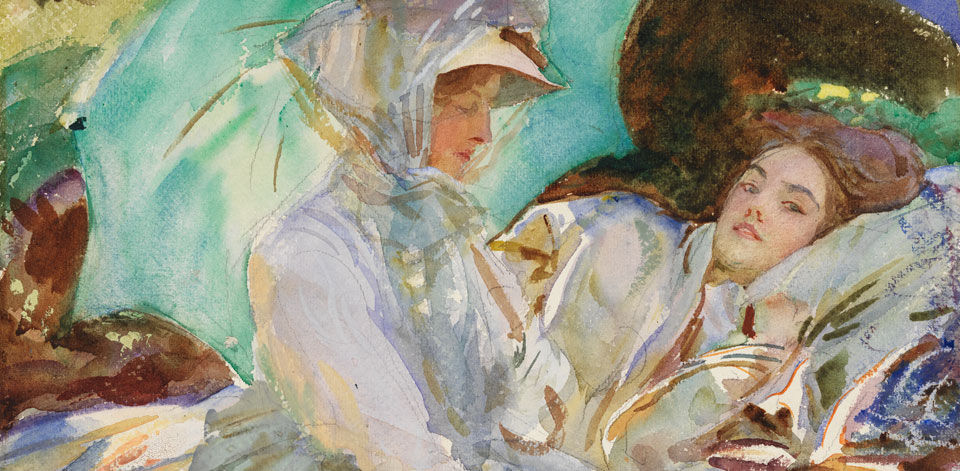
Many of Sargent’s watercolor works include friends and companions, often lounging, reading, or resting during travels. These paintings feel almost like visual diary entries.
There’s a sense that Sargent is not trying to impress anyone here. Instead, he’s exploring what catches his eye: the way sunlight hits a white garment, the rhythm of shadows across a wall, the geometry of sails or tents. These works suggest an artist rediscovering the pleasure of looking.
They also hint at a more private side of Sargent, a side that was less concerned with reputation and more interested in experience.
Legacy and Influence
Although Sargent was already famous for his portraits, his watercolors gained significant recognition during his lifetime. Exhibitions in London and New York were well received, and collectors quickly took interest.
Today, art historians often view his watercolors as central to his legacy, not secondary to it.
They influenced later artists who sought to balance technical mastery with spontaneity. In many ways, Sargent’s watercolors anticipate modern approaches to painting, where suggestion can be more powerful than detail, and where the artist’s hand remains visible.
Next, see more of Sargent's portraits. They're the inspiration for Sargent's Deadly Commission, a historical mystery.
Keep scrolling for more watercolors!


Comments